Stages of the Public Tender Process in Spain: Complete Guide 2026

Public procurement connects organizations that need goods or services with companies that can provide them. To optimize the management of these procedures, it is necessary to understand the complete workflow and the phases of the public tender process from both perspectives: that of the contracting authority (who publishes) and that of the bidder (who offers).
Below, we detail the regulatory stages that make up the file and how technology allows each of them to be streamlined.
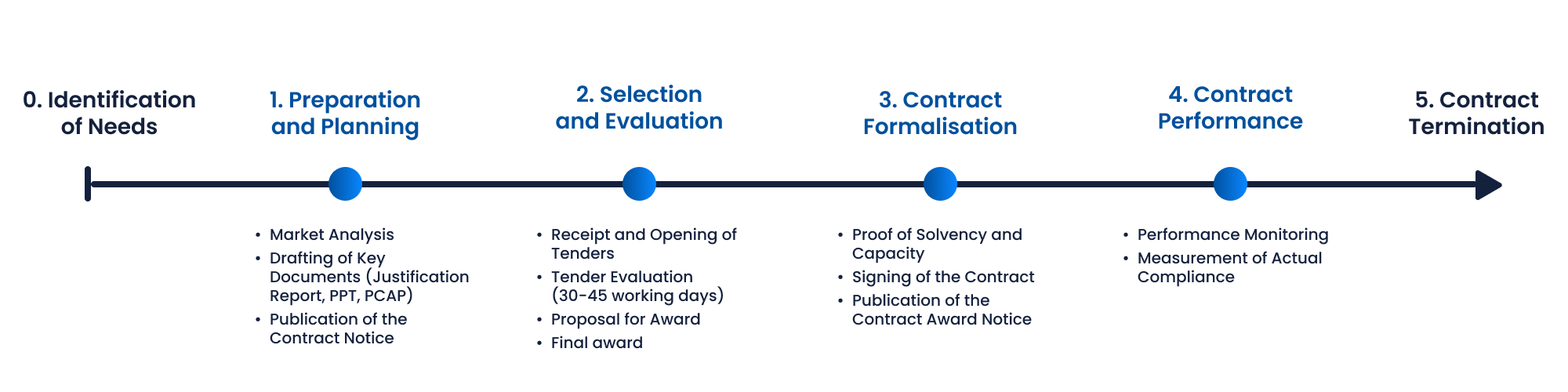
Process Phases for the Public Entity
From the administration's perspective, the procedure is governed by the Law on Public Sector Contracts (LCSP) and seeks to guarantee spending efficiency and legal certainty.
1. Preparation and Planning of the Tender
This internal phase covers everything from the detection of the need to the publication of the notice on official portals such as the Public Sector Contracting Platform.
The contracting authority must define the object of the contract, secure the budget, and draft the key documents: the justification report, the Technical Prescriptions (PPT), and the Specific Administrative Clauses (PCAP).
- In this stage, the use of market intelligence tools allows consulting historical data of similar tenders to adjust prices. This technology is key to articulating preliminary market consultations (Art. 115 LCSP) with guarantees, analyzing the real capacity of the sector to satisfy the need before tendering. Likewise, the generation of documents with AI facilitates the drafting of PPT and PCAP drafts, applying automatic validations to reduce regulatory errors before publication.

2. Selection and Valuation of Offers
After the publication and receipt of proposals, the contracting committee proceeds to open them. The objective in this phase of the procurement process is to select the offer with the best value for quality-price, evaluating technical criteria (value judgments) and economic ones (formulas).
3. Awarding and Formalization of the Contract
Once the proposals are classified by order of valuation, the pre-award requirement begins. In accordance with Article 150.2 of the LCSP, this procedure is not directed at all participants, but only at the bidder who has submitted the best offer, who is requested, in addition to the accreditation of their capacity and solvency, the constitution of the definitive guarantee and, where appropriate, the supporting documentation of the assignment of means.
After the correct completion of this procedure, the award resolution is issued. Subsequently, and respecting the waiting period in cases susceptible to Special Appeal (REMC), the contract is formalized.
In this phase, AI tools for document analysis allow assisting in the validation of certificates, speeding up the verification of current requirements and reducing administrative times.
4. Execution of the Contract
The provision of the service, work, or supply begins. The public entity assumes the supervision function to ensure that the execution complies strictly with what is stipulated in the specifications.
5. Extinction of the Contract
The tender process ends when the established period expires, including possible extensions, and the file is liquidated after receiving the service to satisfaction.
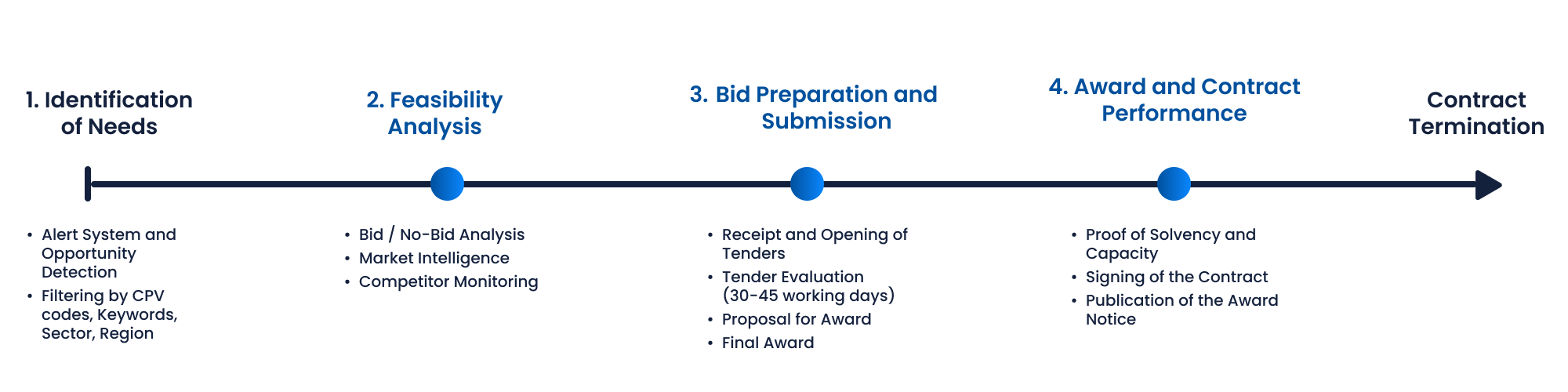
Process Phases for the Private Company
For the supplier, participating in the public tender process requires focusing on business identification and offer competitiveness.
1. Opportunity Detection (Needs)
Given the number of daily announcements on multiple platforms, the first step is to identify the right tender.
- To avoid inefficient manual searches, it is recommended to use customizable real-time alert systems. These tools allow opportunities to be filtered not only by CPV code, but also by specific keywords, sector, or geographical area, ensuring that the company receives only relevant tenders.
In this phase, the analysis of technical solvency is usually the biggest bottleneck. To speed it up, AI not only summarizes the documentation but also crosses the PCAP data with the company's history to offer an immediate compatibility percentage, facilitating the early discarding of non-viable opportunities.
2. Feasibility Analysis
Before dedicating resources to preparing a proposal, the company must decide if it is profitable to bid (Go/No-Go analysis). This implies reviewing the specifications to verify solvency requirements and economic margins of the tender.
Technological optimization: The use of features such as AI summary of specifications or an expert chatbot loaded with the tender allows key data to be extracted from the file immediately (such as required classifications or award criteria) to make quick and informed decisions.

3. Preparation and Submission of the Offer
If the analysis is positive, the company proceeds to the drafting of the technical memorandum and the economic offer. It is critical to adjust the proposal to the valuation criteria and present it in due time and form to avoid exclusion from the tender process.
4. Awarding and Execution of the Contract
If the company is the successful bidder, it must provide the final administrative documentation and formalize the contract. Subsequently, the project execution begins according to the commitments acquired in the offer.
Checklist of Critical Errors That Can Exclude You from the Process
Even with a brilliant technical offer, many bidders and contracting authorities commit formal errors that can invalidate all previous work. The regulations are strict, and the slightest defect in form can mean direct exclusion.
Below, we detail the essential control points where you cannot fail:
For Bidding Companies:
- Envelope Confusion (Offer Contamination): It is the most frequent and lethal error. Introducing information from the economic offer (Envelope C - Automatic criteria) into the envelope for technical documentation subject to value judgment (Envelope B) violates the principle of secrecy of propositions. This causes the automatic and irreversible exclusion from the tender.
- Invalid Electronic Signature: It is not enough for the document to appear signed. The signature must be valid, be in force at the time of presentation, and cover all required files (electronic fingerprint). A certificate expired or revoked at the time of submission will leave the offer out.
- Unaccredited Solvency: Bidding for a tender whose economic requirements (turnover) or technical requirements (certificates of good execution) exceed the company's capacity. If you do not comply by yourself, it is mandatory to formally resort to the integration of solvency with external means (Art. 75 LCSP) presenting the written commitment of said entities.
- The Last Minute Trap: Technical failures on the Public Sector Contracting Platform (PLACSP) or on regional platforms during the last minutes of the deadline are usually not a valid legal excuse for late admission, unless a general system failure attributable to the administration is proven.
For Public Entities:
- Specifications with Discriminatory or Limiting Criteria: Establishing solvency requirements or technical prescriptions that are disproportionate and unjustifiably limit competition. This is a direct reason for filing a Special Appeal in Contracting Matters (REMC), provided that the estimated value of the contract exceeds the established thresholds (Art. 44 LCSP), paralyzing the procedure.
- Lack of Cost Breakdown: The base tender budget must be correctly detailed. It is imperative to break down direct and indirect costs and, specifically, the estimated wage costs according to the reference labor agreement (Art. 100.2 LCSP). The omission of this breakdown is a frequent cause of nullity of the specifications.
- Insufficient Motivation in the Award: Awarding the contract based on subjective criteria (value judgments) without a technical memorandum that details why one score is higher than another. The lack of motivation generates defenselessness and is one of the main causes for appeals being upheld in administrative courts.
Tendios Tip:
Many of these human errors, such as the lack of cost breakdown or confusion of solvency requirements, can be prevented using AI assistants that validate the coherence of the specifications and automatically analyze the file requirements before submitting the offer.
Frequently Asked Questions About the Public Tender Process
How long does the complete process of a public tender take?
The total period varies according to the type of procedure and object of the contract. In a standard open procedure:
| Phase of the Process | Estimated / Legal Term |
|---|---|
| Internal preparation | 1 to 3 months |
| Publication and submission of offers | 15 calendar days: Simplified open procedure (Supplies and Services)20 calendar days: Simplified open procedure (Works)35 days: Contracts subject to harmonized regulation (SARA) |
| Evaluation of offers | Up to 2 months |
| Awarding and formalization | 15 working days (waiting period or standstill before signing) |
Approximate total: 4-6 months from the detection of the need to the signing of the contract.
- Note: Complex procedures, such as those with negotiation or competitive dialogue, can extend between 8 and 12 months.
Can a company bid for any tender?
Not necessarily. It must meet requirements of:
- Capacity to act: Be legally constituted.
- Professional authorization: Have specific sector authorizations (e.g., health licenses, industrial, etc.).
- Economic and technical solvency: Demonstrate sufficient experience and resources according to the thresholds of the PCAP.
- Business classification: In some works and services contracts, it is mandatory to be classified in the corresponding group and subgroup.
It is fundamental to read the solvency requirements BEFORE starting to prepare the offer to avoid exclusions.
Can the administration cancel a tender after publishing it?
Yes, the contracting authority may decide not to award or conclude the contract at any time before the award, provided there are justified reasons (Art. 152 LCSP). However, the economic consequences for the bidder vary according to the legal figure used:
- Withdrawal (Desistimiento): Occurs due to a non-rectifiable infringement of the preparation rules or the procedure (a legal error by the contracting authority). In this case, there is a right to compensation. Article 152.3 of the LCSP specifies that the administration must compensate bidders for the original expenses they have incurred for the preparation of the offer. Furthermore, withdrawal does not prevent the procedure from being initiated again once the error has been rectified.
- Renunciation (Renuncia): Is due to duly justified reasons of public interest (for example, the need disappears). In this case, the rule does not contemplate general compensation for bidders for preparation expenses, unless bad faith or extreme arbitrariness is proven. Unlike withdrawal, renunciation prevents promoting a new tender on the same object while the alleged reasons persist.
Conclusion: The Advantage of Mastering Both Perspectives
Understanding the phases of the public tender process from both perspectives —administration and company— is not just an academic exercise: it is a tangible competitive advantage.
GovTech and Goval technologies are democratizing access to this information. What previously required years of experience and specialized teams can now be optimized through artificial intelligence tools that analyze historical data, validate documents, and predict probabilities of success.
For public administrations:
Knowing the difficulties that bidders face when interpreting complex specifications allows designing clearer procedures, which translates into:
- Greater concurrence (more offers = better competition)
- Fewer appeals and claims
- Higher quality executions
For private companies:
Understanding the internal valuation process allows:
- Preparing offers more aligned with the award criteria
- Anticipating documentary requirements
- Optimizing the time dedicated to each public tender
The future of public procurement is more transparent, more efficient, and more accessible for all actors. The key lies in mastering the complete process and leveraging the right tools in each phase.


Related articles