Public Tender Automation: How to Save Costs & Time

Tender automation is the use of advanced technologies, such as artificial intelligence and big data processing, to simplify the phases of detection, analysis, and management of business opportunities with the public sector. Its main objective is to eliminate repetitive manual tasks that do not add value, allowing procurement teams to focus on strategy and improving success rates.
For many commercial directors and bid managers, the workday consists largely of manually tracking public tenders. Reviewing official gazettes, jumping between the Public Sector Contracting Platform (PLACSP) and dozens of regional profiles, and downloading tender documents of hundreds of pages only to discard the opportunity after hours of reading due to incompatibility with the company's activity or lack of requirements.
This article covers the automation of tender search and monitoring processes. If you are looking to understand how AI agents make decisions and execute tasks autonomously within the process, we recommend this article on AI Agents.
Let’s look at real data on how much it costs to maintain this manual process and how tender software based on intelligent aggregation transforms this sunk cost into a competitive advantage.
The Problem with Searching for Tenders Manually: Real Data
The problem with manual bidding is the erosion of operating margin. According to sector data, there are 8,393 active contracting authorities in Spain that publish more than 120,000 tenders per year. Attempting to cover this volume manually is humanly impossible.
When a qualified technical team dedicates its time to manually searching for data instead of bid engineering, the company incurs a massive opportunity cost.
How Much Time You Really Waste Searching Official Gazettes
Let’s make a conservative calculation based on the average cost of a bid technician in Spain:
- The daily cost: A technician spends an average of 90 minutes a day on searching, filtering, and the first reading of files (PCAP/PPT).
- The annual cost: That is 45 full working days a year (almost two months of effective work) dedicated exclusively to finding papers, not writing winning proposals.

Fragmentation: Why Are There More Than 50 Procurement Portals?
Fragmentation of information is the enemy of profitability. Although the Law on Public Sector Contracts (LCSP) promotes interconnection, the reality is that information does not reside in a single perfect repository.
To have total market coverage, a company must monitor a complex ecosystem:
| Portal Type | Examples | Frequency of Use |
|---|---|---|
| Central Platform | PLACSP (Public Sector Contracting Platform) | Daily |
| European Journal | OJEU (Official Journal of the European Union) | Daily (for large amounts) |
| Regional Portals | Junta de Andalucía, Generalitat de Cataluña, Madrid... | Variable (sometimes they do not sync in real-time) |
| Local Entities | Large City Councils, Provincial Councils | Specific by zone |
Attempting to monitor this manually implies a very high risk that a perfect tender for your company will be published on a regional portal and expire without anyone detecting it.
Tender Aggregator Software: What It Is and How It Works
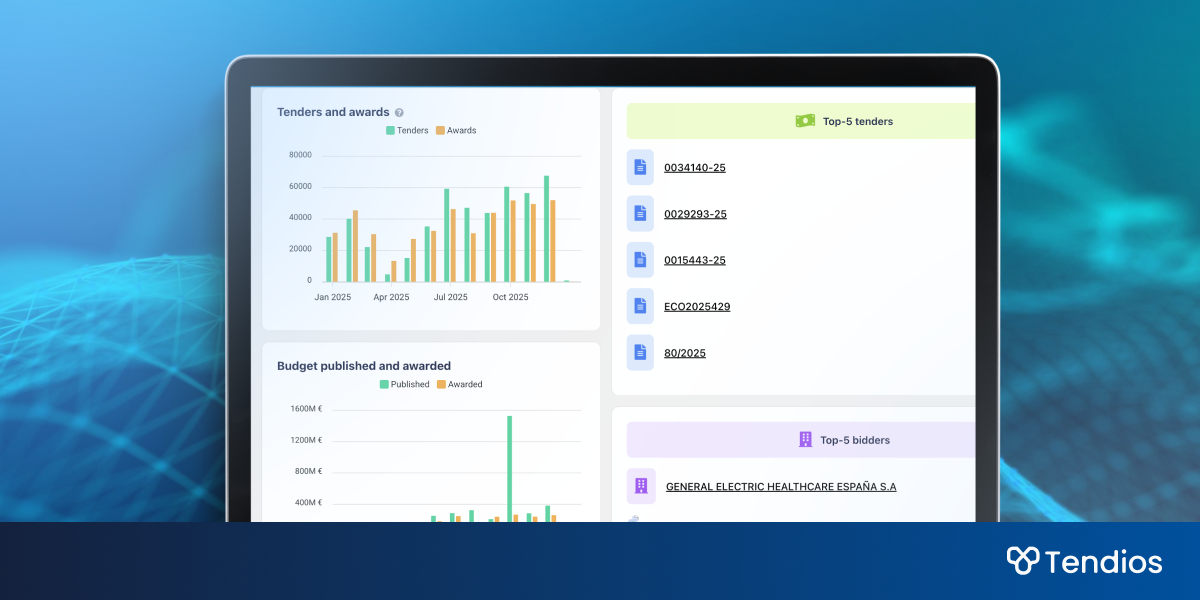
An aggregator is an engine that connects in real-time to all sources (PLACSP, OJEU, and regional portals), centralizing the information in a single control panel. This eliminates the time spent "digital commuting" between websites.
Smart Alerts with CPV Codes
The problem with email is not the lack of information, but the excess of irrelevant information (noise).
Automation allows filtering by CPV codes (Common Procurement Vocabulary) and semantic context, sending clean alerts only for those tenders that fit your commercial profile.

Automatic Document Analysis
This is the biggest leap in productivity. Specialized AI (like the Tendios ChatBot) automatically reads and classifies documents. The system instantly extracts critical requirements such as economic solvency, required business classification, and award criteria, allowing for an immediate feasibility analysis (Go/No-Go).
Real-World Use Cases by Sector
Automation impacts differently depending on the industry:
- Construction and Civil Works: A medium-sized construction company reduced its search time from 12 hours a week to 30 minutes, automatically filtering out works that required a business classification they did not possess.
- IT / Software Consultancy: Automated the detection of keywords in technical specifications (PPT) to find tenders where specific technologies ("Kubernetes", "AWS") were mentioned but did not appear in the contract title.
- Service Company (Cleaning): Doubled the number of offers submitted per year by eliminating the administrative bottleneck of reading specifications, reallocating staff to the drafting of technical memorandums.
Comparison: Manual vs. Automated Process
| Variable | Manual Bidding (Traditional) | AI Bidding (Tendios) |
|---|---|---|
| Detection Time | 60-90 min/day | Automatic (Personalized alerts) |
| Reading Documents | Sequential, slow, and prone to fatigue | Immediate extraction of key data with AI |
| Coverage | Limited (known portals) | Total (Spain + Europe) |
| Risk of Error | High (missed opportunities) | Minimum (precise alerts) |
| Annual Cost (man/hours) | ~350 hours | ~20 hours (alert management) |
Frequently Asked Questions About Tender Automation
How many procurement portals are there in Spain?
There are more than 50 relevant sources adding up the state platform, the regional ones, and the main city councils that require independent monitoring.
What are CPV codes and why are they important?
The CPV codes (Common Procurement Vocabulary) is a numerical code system used by the EU to classify contracts. Filtering by CPV is much more accurate than using generic keywords.
Conclusion: Reallocate Talent Where It Adds Value
Continuing to read Official Gazettes manually in the age of artificial intelligence is a structural competitive disadvantage.
By automating the detection and preliminary analysis phase, you free up your best resources so they can focus on what AI cannot do: designing the best technical strategy, adjusting costs to the cent, and negotiating with suppliers.
Do you want to know how much money your department is losing on administrative tasks?